Sunday, July 28, 2013

Japanese Family Life


I’m really glad Japan Society arranged for us to have both a suburban homestay and a rural homestay—if anything it helped highlight the fact that just like the United States, Japan is also filled with great variations when it comes to cultural or familial norms. Being able to debrief with the other teachers about our homestay experiences as well was incredibly useful, because in our discussion we found more divergences, but were also able to pull out some similarities and trends. Here’s what we found:

Seems like your average family in Japan maintains fairly rigid gender roles as a method of creating stability and functionality in the home. Most of our families had a structure in which the dad worked long hours and didn’t return home until 9 or 10 in the evening. Meanwhile, the wife generally stayed at home with the kids and took responsibility for cooking, cleaning, etc. I saw quite a broad spectrum of this—seemed like in my Arida family, for example, this role was more clearly defined, as in if the host dad wanted a coffee, he’d literally ask the wife to do it instead of getting it himself, whereas in Obu I saw the host dad help clear the table, do the dishes, play with the kids, all that. But in general, you definitely have a “men work hard, and women work just as hard at home” kind of system. I asked Yuki if she ever thought about going back to work, and she said yes, a little wistfully, but she didn’t seem resentful that she had quit her job for her family.

The really surprising thing to all of us was the fact that it’s apparently pretty standard for kids to sleep in the same room as their parents. For instance, in my host family in Obu, they had the 4-year old daughter’s bed pushed right up against the big bed in the master bedroom, with the crib just alongside for the baby. As Americans, we were all pretty shocked by this. But what about their intimacy as a couple? What about their private time? Several of us asked about “date night” and discovered that the concept pretty much doesn’t exist. In fact, Yuki told me flat out that it’s frowned upon for parents to hire a babysitter in Japan. The only way you can leave your house without your kids is if you have your parents watch them for you. What I understood from talking to Yuki is that she sometimes was able to go out with her friends and her husband was sometimes able to go out with his friends, but they more or less never went out together. This was pretty incredible to us as Americans. We’re basically the most individualistic and selfish society on earth and here we were being shown a life in which you’re expected to give up romance, privacy, and career (if you’re a woman) for your family.

So what about this family? Most of the families we lived with seemed fairly healthy and happy (keep in mind, these families self-selected to host a foreign visitor), and the kids were pretty well-behaved. You know how whenever you’re with parents who have young children, there’s always a moment sooner or later when the parent just lose it and start screaming? I never saw that happen even once. When I mentioned it to Rob, he suggested that that was probably a function of the parents not wanting to cause a scene in front of guests—even if this is the case, it’s still amazing to me that public child tantrums are avoidable. All of us remarked on how calm and laidback the families were. A “hands-off” approach seemed to be happening with the parenting. This contrasts quite sharply with your typical middle class American family you see in the streets, in which the scenario is usually that a kid starts crying and the mom is immediately slobbering all over herself to appease it. A lot of us commented that there were a lot of toys and very little TV. In my family, there was maybe a half hour to an hour max of children’s TV a day. I was astonished by how little TV there was. It kind of seems to fit with the lack of technology in general that we’ve seen here. I’ll get to schools later, but classrooms are basically just chalkboards. A lot of the hotel rooms we’ve been in have been kind of dated in terms of gadgetry and TVs. I can’t seem to find a coffeehouse that has even a single outlet. And I think we were all surprised by how few tablets, etc, we’ve seen in general circulation. It’s not as if technology doesn’t exist or that Japan is behind—obviously it’s not. It’s just that it’s not as present as we were expecting given this high-tech electronica image we have of Japan.


Now, I don’t know what any of this means, I’m just making observations, but I’m going to throw out there that Japan is just much more family-oriented than I expected. In the past few years, apparently, they’ve increased paid maternity leave to over a year. When a woman gets pregnant, she gets handed all this information on healthcare, vaccinations, an schools by the government. Even in the public sphere, the family is just present. I don’t have kids, so I can’t really be an authority on this, but I get the impression that kids are kind of supposed to be hidden. No one wants to know that a woman is nursing, much less see it. Everyone glares whenever a baby is crying or a kid is throwing a tantrum. I never thought about what a woman with a baby must have to do when she needs to pee, but in Japan, they’ve thought about it! Women’s bathrooms usually have stalls equipped with a baby holder for a woman to put her baby while she pees! There’s usually also a little boy’s urinal for a little boy to use in the women’s restroom so he doesn’t have to go to the men’s room alone. I saw public spaces for kids everywhere in Japan. In a bakery, I saw a little playroom to the side for kids. It’s really clear to me that Japan is a society that considers families in a way that the United States doesn’t.
Baby seat in a stall in the women's room.

Little boy's urinal in the women's restroom

Small play area in a local bakery

Friday, July 26, 2013

Homestay in Arida, Wakayama Prefecture


Rice paddies
View of Arida from the Tanakas' hillside farm. 


My second homestay was in a more rural area where the people are predominantly farmers or fisherman, and the dynamic was radically different from what I saw in Obu. This homestay was both more interesting as well as more uncomfortable for me, and I think a lot of that probably has to do with the rural/urban divide laid on top of being with an unfamiliar family. There was a tendency among us Americans to compare the suburban family in Obu to a suburban American family, and likewise with this rural homestay, and I think to some extent, the comparison is very apt. In Obu, we drove around in a minivan and went to a big superstore to shop. Most of the families were younger with kids. In Arida, it like smalltown America  in some ways—everyone knew each other, gossip flowed like wine, people were a little more open and gregarious and “earthy” if you will, and the town seemed to be mostly older people since the youth had all packed up and moved to the city.

I think I can illustrate what the difference is between Obu and Arida by discussing my first night there. Remember in Obu, when there were formal introductions and gift exchanges with the mayor and a TV crew? Not to brag, but we were kind of a big deal. You know what happened Arida? They led us to this little community center were we waited in a tatami room before we met our host families. Rob casually mentioned that we would be having dinner in the community center, then mysteriously had us line up in some predetermined order for going upstairs to the dining room. So we lined up, walked up the stairs and through the hall…and then into a banquet room filled with basically the whole town. Everyone important was there. The vice-mayor, all the principals and vice principals from the local schools, our host families, and a bunch of other people whose identity I never learned. More formal speeches, then we were presented to our host families and sat with them for the banquet that followed. Looking around, I could see that everyone who made a speech had a copy of a SEATING CHART to refer to.  Now, in both Obu and Arida we were treated like local celebrities, but in Obu the host families didn’t really know each other, and everything was highly structured and formalized, hosted by the Obu International Association. In Arida, it genuinely felt like an entire community had come out to greet us.

Now, what did this mean in terms of setting the tone for the rest of my stay? Well, to be frank, it was a bit of a zoo and circus situation in which the host families had first row seats to watching the monkeys ride unicycles before we moved on to the next town. I suppose that’s only fair, though, since I’m now turning the tables and analyzing their behavior like a sociologist. =)

Here’s what it was like—my host family, let’s call them the Tanakas, were the most welcoming hosts you could ever wish for, and you could tell they genuinely wanted me to enjoy myself and be comfortable. The family make-up was the father and mother, both in their 60s I’d say, and the mother’s mother. They have two kids who are grown who live hours away and rarely visit. I want to try and describe my host father, since I interacted with him more than the other two. Hosting is clearly his gig, he does it every year, and the first thing he did when we got into the house was show me Facebook pictures of the last two people he hosted. He’s an older guy, but very spry and brown, I guess from working on the farm for most of his life (I actually noticed that more people in Arida were tanned than we’ve been seeing). He’s an easy-going type and laughs constantly. In fact, I’d venture to say he’s got a touch of the Most Embarrassing Dad In The World Syndrome in that he’s constantly repeating his stories and telling jokes that only he thinks are hilarious. He loves to refer to himself as “A Bad Boy” and plays up his laziness like it’s an old comfortable joke. I’m not sure how true it is, but he himself told me that while his mother-in-law and wife work on the farm all day, he usually just sleeps and eats and plays golf. Indeed, I think that’s the public image he’s comfortable with. He definitely enjoys the persona of Host that he can take on when foreign visitors come, and though his grasp of English grammar is weak he uses his words loudly and frequently and wildly gesticulated. I think he enjoys the attention and power of being the “interpreter.” In contrast, his wife—whom I really liked!—is quiet in public. The first night I met her I thought she was very severe, but turns out that is just her public face. At home, she laughs and jokes and chats lightly with host dad all the time. That said, she stayed home for almost all of the outings we had.

Mrs. Tanaka going about her morning in the kitchen

In contrast my host father—along with several other host dads—followed the teachers around the next day as we did our visit to city hall and two local schools. Whatever we were doing, you could always turn and see a few of the host dads laughing with each other and snapping pictures of us. They seemed to be having a grand old time, and I guess if they’re retired we would seem like an exciting change. They most definitely traded stories of us. I know this because since I can understand at least a little Japanese, I got the general gist of most of what the dad said in front of me. For instance, I heard the story of how Brad (another educator) was deathly sick the first night and his host mother offered him a banana but he wouldn’t take it three times over the course of the day, once to my host mother, and twice to other host dads. I know you’re thinking there’s more to this story, but nope, that’s the whole thing. Host dad also talked non-stop about me, unfortunately, indicating imminent full-blown Embarrassing Dad Disease. The day after he took me out for karaoke, he opened almost every conversation he had with a description of how I sang two Chinese songs and one Japanese one, isn’t that amazing? I got the playback on how I wrote an incredibly difficult kanji during calligraphy class, and when we met his daughter and her boyfriend (yes, I was an excuse to extort a visit from her all the way from Osaka), he actually pulled his camera out and began showing them pictures of me practicing a hit in Kendo club! I do understand where all this is coming from, and I’ll admit that Americans would probably do the same thing—behind their back, that is. I think what made it so uncomfortable is that it was playing out right in front of me.

One of the things we did was work clearing the weeds out of a rice paddy with 5th graders from the school. No pictures of me doing it because my host dad actually took a nap in his car and didn't wake up in time to take pictures, haha.
We also watched some of the local high school clubs. Minoshima High School is actually nationally ranked in several sports, so their sports clubs are also very high caliber. This is their club sumo practice. 
I guess any time you travel to another place, you will feel “other” no matter what. And in a homestay situation, everything will inevitably be a little artificial—I mean, what do you really know about this foreign person except: “This is Karen, she speaks Chinese. Her Japanese is excellent, and she has lived all over the United States. She’s thankfully not a vegetarian and she loves spicy food, isn’t that great?” I think that any encounter between two cultures is necessarily somewhat uncomfortable, and if you really want to learn about other people you kind of just have to embrace the discomfort. Every year that I host a Chinese teacher, I appreciate and understand this that much more. Seeing what it’s like from the other side (being the visitor instead of the host) only clarifies my understanding that it’s this uncomfortable feeling that is actually at the heart of traveling and exploring.

In conclusion—I had a valuable experience in Arida. Do I want to go back? Not so much. But I’m grateful to my host family for opening their home to me and showing me their world. In my time there, I visited a local karaoke bar, went to Adventure World to see the pandas, checked out the local vacation getaway beach, and worked in a rice paddy with 5th graders. I must say that Wakayama is a very beautiful place and the mikan (mandarin oranges) are indeed delicious. You know I snatched up a bottle of that Arida mikan wine to take home. Slurp!

Me with host sister at Adventure World
Pandas in tense and heavy bamboo-eating competition

Mmmm, mikan wine!

Wednesday, July 24, 2013

Hiroshima and the Atom Bomb

1945
2013


Ok, so this blog entry has been the most difficult for me to write because I have so many random thoughts about EVERYTHING!  I decided to frontload some basic pictures from the Hiroshima Peace Memorial Museum with simple captions first, and let the pictures tell the story of my experience, THEN write my thoughts about them.

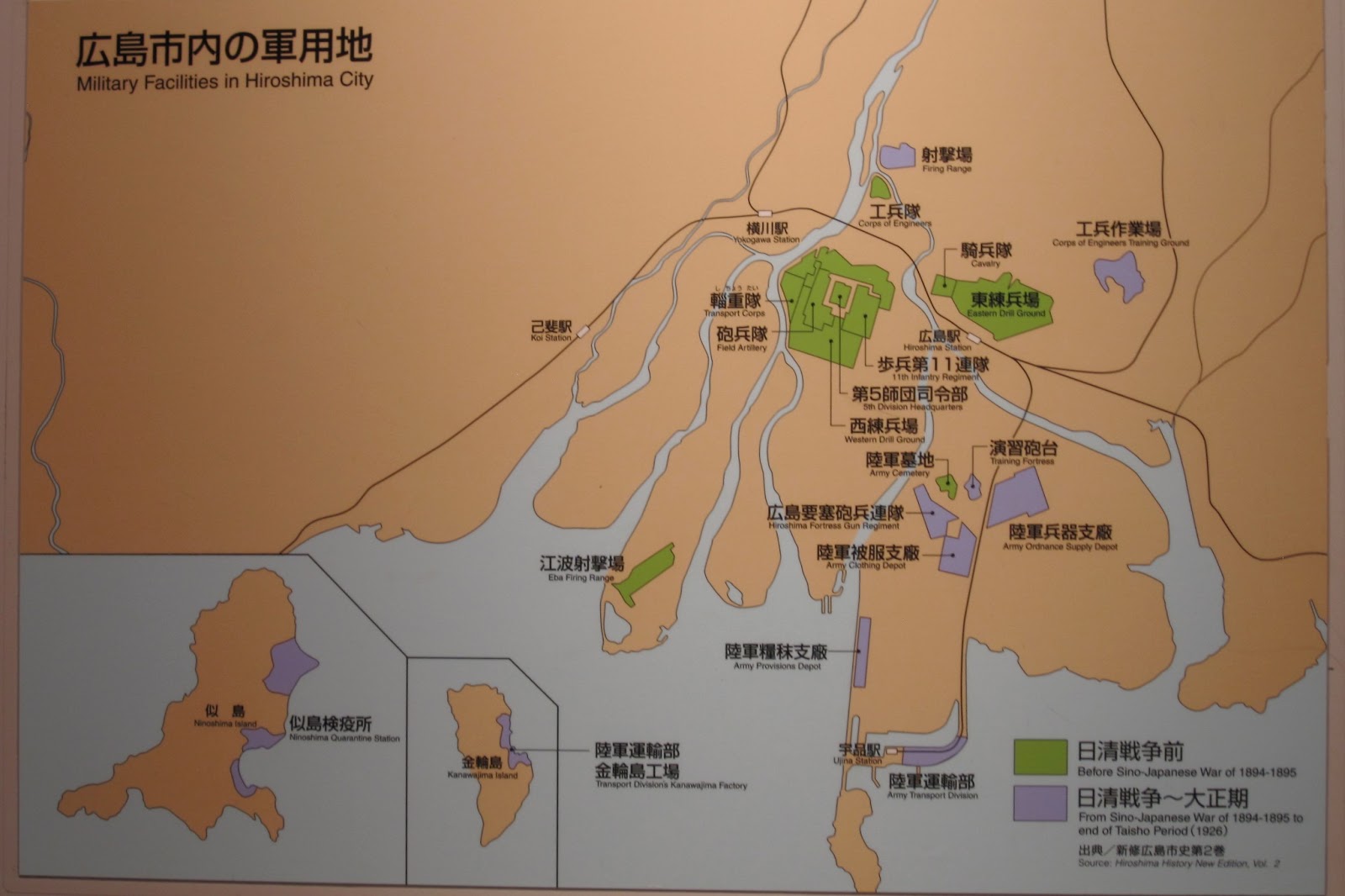
I didn't realize that Hiroshima actually housed a huge military presence. It's a port city and has thus historically been a place for the mobilization of forces before expeditions to Korea and China, for example, or for many of the WWII Pacific endeavors. This map shows military posts in the city Green means it was there before 1894 (pre-Sino Japanese War), purple means it was built sometime between then and WWII.
I had no idea that there whole military maneuvers carried out to practice the dropping the A-bomb. Every yellow mark on this map represents a spot where a "dummy a-bomb" was dropped in the two months before the real bomb. Apparently the dummies killed almost 2000 on their own. 
Model of Hiroshima before the bomb
Model of Hiroshima after the bomb


A shirt burned most of the way through from the bomb


A lunchbox with its contents charred from bomb.
The heat burned through the black ink writing that had been on this cloth since black absorbs more heat
Metal that bubbled up from the heat of the bomb.


This radioactive "black rain" was sometimes consumed by survivors, desperately thirsty after becoming sickened by radiation. Drinking could kill them or make them sicker, giving them diarrhea for months.


And now for the lengthy discussion:


Victims for Peace?
Memorials and museums can be very tricky sometimes, because inevitably there will be some sort of perspective involved, and then it becomes an issue of whose perspective is it, how “accurate” is its recounting of events, what does it deliberately leave out, what does it fail to consider, and why has it undertaken the task of memorialization to begin with. Places that I can think of that have had to deal with these thorny questions are the Vietnam Memorial, Auschwitz (sp?), the Nanjing Massacre Museum, the 9/11 Memorial—the list goes on. For the subject of the atomic bomb and Hiroshima, recall the controversy over the manner in which the Smithsonian should display a restored Enola Gay (US plane that dropped the bomb) to mark the 50th anniversary of the bomb. What’s the story there? The US won the war, so is this an artifact of victory and veteran pride? Or a symbol of the human tragedy that resulted from the bomb? What the Enola Gay means to Americans might be quite different from what it means to Japanese. In any case, some people threw a fit at the idea of suggesting that the United States did wrong to drop the bomb. There’s some good info related to the controversy here: http://digital.lib.lehigh.edu/trial/enola/

In Hiroshima, we visited the Hiroshima Peace Memorial Museum to yes, learn about the bomb and city, etc, but also to consider some of these questions. For me, I also came into it wondering how I could raise questions for my students about war and ethics and technology. How does technology bring new moral dilemmas or responsibilities into play? Does technology that removes the personal nature of killing facilitate state violence and war? Is there a moral code to waging war? Should there be one? Is it even meaningful to speak of “conventions of war” as long as we still wage war? (and also, has anyone ever really given a crap about the Geneva Convention?) I’ve been wanting to do something with nuclear deterrence and drone warfare for a while now, but have been looking for a way to tie in more “mainstream” standardized test material into it. I don’t know how much standardized test material I got out of this, actually, but I do know that I came out of this city with so many more questions than when I entered it—if I can somehow do the same for my students, then I’ll have accomplished my goal!

So one big question I have is, who’s a better proponent of peace than a victim of terrible violence? Japan today has kind of a dual symbolism. It’s often touted as the only pacifist country in the world, the only country without its own army, a country that has low crime rates, a country that having experienced the horrors of the bomb now advocates peace. On the flip side, we also have this image of the Japanese war criminal who rapes women and kills children indiscriminately, and the looming Japanese empire out to conquer all of the Pacific, and the picture of Pearl Harbor being bombed to smithereens to a theatrical Hollywood soundtrack. To some extent these identities are laid out for us chronologically, so that we have a vague idea that evil has somehow evolved into good. It’s really difficult for us to look at both visions of Japan at the same time because they don’t go very well together.

I bring up this dual persona only because this is really one of the most obvious issues the museum had to struggle with from the beginning. Victim or villain, either side is a caricature, and any museum worth its name would want to attempt a more balanced approach. Here’s how the museum dealt with that: The building is divided into two parts—the first half covers the history of Hiroshima as a military outpost and port city and goes through the early stages of WWII, including Japanese aggression—albeit slightly glossed over—then the 2nd half of the museum covers the science of the bomb and both the immediate and long-term effects. You can probably tell from this description which section the pictures above fit into. Now here’s where it gets interesting. The 2nd half of the museum begins with the visitor walking through a long corridor built to look like the inside of a damaged brick building. The walls behind the brick are painted with a landscape of razed and smoking trees and buildings backlight by a fiery glow. This is obviously meant to duplicate the experience of a survivor moments after the bomb exploded and to evoke the loneliness and despair of a city completely annihilated. As you turn the corner, you’re greeted by the sight of mannequins, faces raw, skin melting, clothes half-burned away. It’s very effective and very emotional, I will say that.

I was unsurprised to learn that the museum originally only contained this 2nd half, adding that first half only after it received complaints that it ignored Japan’s military aggression. Can you imagine starting your museum experience with that corridor walk? Whatever came after, it would be very difficult to return to an analytical frame of mind. That section actually reminded me of the Nanjing Massacre Museum in Nanjing, China, which was BLACK, very dim and somber inside, and filled with mannequin scenes meant to make you feel horrified and dismayed. I think it’d be pretty difficult to walk out of that museum not feeling just a little angry towards Japan. In contrast, I’d have to say the Hiroshima Peace Memorial Museum did a respectable job of both evoking an emotional response AND conveying important scientific and historical context. Although a fellow teacher said she felt a little bit uncomfortable at times as an American, I didn’t actually get that sense at all. If anything, I felt that military aggression by BOTH the United States and Japan were downplayed. The firebombing of Tokyo, for instance, was scarcely mentioned. Forget about the Nanjing Massacre or the Bataan Death March.

I almost felt that the message being pushed was, “It doesn’t matter what happened before, what’s most important now is peace.” A subtle evasion of both casting blame and accepting blame by taking on the burden of a more righteous mission: world peace. Right away you’ll notice the name of the museum—the museum has an agenda and is very straightforward about it. It exists to promote the banning of nuclear weapons and to promote world peace. That’s the mission of the museum, and it’s visible in various aspects of its exhibitions. For instance, there are several walls that display hundreds of letters written by the mayors of Hiroshima to every country that has tested nuclear weapons on every known incidence of said testing (hint: most of them are to the United States and the Soviet Union. The most recent one is to Obama). There’s also a place for signing petitions to convene nuclear disarmament talks, etc.


Now, you can’t really take on the mantle of World Peace Promoter without also accepting a certain authority imparted by victimhood. Obviously I have zero problem with anyone promoting world peace and the banning of nuclear weapons, but I think the peace persona that Japan has taken on sometimes makes it way too easy to disguise the role the Japan and the Self-Defense Forces currently plays in American militarism.  Just a thought.

I want to discuss the surrounding environs of the memorial museum now. This museum and the park that surround it are located very near the epicenter of the atomic bomb dropped on city in 1945. Its main landmark is the Peace Dome (of note is that it’s actually called the “atomic bomb dome” in Japanese), the hollowed out, blasted remains of a building that is one of the few original structures left. 


The park is beautiful, excellently maintained, and contains numerous memorial statuary of its own, installed over the years for various reasons. There is, for instance, one devoted to the many schoolchildren who died. Before the bomb, children 8-12 had already been evacuated, while children older than that were put into workteams to demolish rows of houses to create firebreaks in the event of firebombing. A number of these teams were at work when the bomb hit. Rob problematized this memorial for us by raising the provocative question—they’re children, but of course they were being put to work for the war effort, so to what extent does that make or not make them combatants? A great question to add to my class discussions of the moral obligations of war.

Strings of paper cranes left at one of the memorials. These are everywhere in Hiroshima, and I think have come to represent the spirit of peace after the bomb, especially after Sadako's iconic story.  Apparently, Sadako's relatives have just donated one of the last 5 cranes she folded to Pearl Harbor. 

Peace Bell memorial. On the bell is carved a map of the world with no lines between the countries. 

Children's Peace Monument. This monument was unveiled on Children's Day (a national holiday in Japan) and commemorates Sadako and all other children who died as a result of the bomb. Sadako was a girl who died from radiation-induced leukemia a few years after the bomb. She folded over 1000 cranes according to the Japanese traditional belief that doing so grants you a wish. Children today visit this monument. The cranes they fold to wish for world peace are housed in the structures you see just behind the statues (now there are too many to house, however).


One of the more interesting side memorials I’ll point out is the memorial to Korean residents of Hiroshima who died in the bombing (some moved there for economic opportunities, some were forcibly brought by the Japanese military for labor). The memorial was originally erected outside of the park by the local Korean community, and not moved into the park until 1999 (shortly after it became possible for Koreans to attain Japanese citizenship without having to take Japanese names). Why should this memorial have been excluded from the sacred inner space to be begin with? I don’t know, but I’d guess it has something to do with the desire to maintain Japanese exclusivity over the rights to claim victimhood from the only atomic bomb ever used in war. We’d discussed already how the bomb, once only significant to Hiroshima, over time took on national symbolic significance. Japan as a nation eventually became the victim of the bomb, and this ideological shift must have been part and parcel of the Peace Movement in Japan in the later half of the 20th century. You can’t really separate Japanese pacifism from its faultless victimhood, which I mentioned already. I think that persona I mentioned earlier, the “peaceful” one, is really something that helped construct post-war Japanese national identity. That might be one reason why Japan didn’t want to acknowledge other victims of the bomb—doing so might make Japanese victimhood less Japanese, if you know what I mean. I also think acknowledging those other victims, some of whom would not have perished had the Japanese military not forced them to move there, recall events that bring that peace-loving identity into question.
The turtle is a Korean motif indicating passage to heaven. There's a bowl of water in front of the turtle. We noticed that water is a common theme in many of the memorials, and there was some discussion whether this had to do with water being a purifying thing in Shinto, or whether it was referencing the thirst experienced by the many victims of the bomb. 


Hibakusha [survivor] Testimonials
Aside from the museum and the park, a big part of my experience in Hiroshima was talking to hibakusha, or survivors of the atom bomb. We spoke to two different survivors. It's one thing to read about a terrible tragedy and the human suffering it causes, or even to see pictures. It's quite another to hear someone talk about their own experiences and emotions. Anyone who has ever heard a Holocaust survivor speak will understand what I mean. As a history teacher, it was also a great opportunity for me to experience oral history, which, like eye-witness testimony, is heavily edited by the speaker after the fact and is not necessarily "accurate." So what makes these testimonies so valuable then? I think it's getting in touch with the human side of tragedy and empathizing. We don't need oral testimony to know what happened, we have plenty of records. The oral testimony though tells us what people remember, what made that lasting impression on them, and it shows us what the people who lived it think is most important.

The first hibakusha we spoke to was Ms. Toshiko Tanaka. I googled her later and found her story here: http://hibakushastories.org/toshiko-tanaka.html .  It's incredibly similar to what I heard from her that night. I guess when you retell a story this important it eventually takes on a practiced manner and becomes almost a performance. In short, Ms. Tanaka was 6 when the bomb hit. She felt the heat blast and suffered from radiation sickness for a few weeks (fevers, coma, burns) and witnessed many deaths and more serious cases. An image that really struck me when she described it was how people's skin looked after--raw, like a peeled tomato. It really stuck out to me that even to this day, she can't look at a tomato at a barbecue without thinking of it. I can't remember exactly when Ms. Tanaka began telling her story, but it was really recently, within a couple of years, I think. In fact, I want to say it was the Fukushima incident that inspired her to speak out (i can't find my notes!). She even began to do some research on radiation on her own and took a trip to visit Chernobyl. That really struck me, that she waited so many years to talk about it but that once something triggered that decision it turned into a kind of mission for her--now she tells her story quite frequently and promotes the banning of nuclear weapons. I could tell that it's difficult to talk about for her--she was very calm and even smiled a couple of times during her talk--it felt very much like a professional curtain that she'd dropped to keep some distance from her topic. Ms. Tanaka is actually an enamel artist, and she discussed that one of the reasons she got into art is because it was an emotional outlet for a lot of the unresolved feelings she had about the bomb. Her art is abstract, but there are definitely many themes relating to war and even the bomb directly. You can check out her art here: http://www.toshikotanaka.com/ 

The second survivor we spoke to was a Mr. Ito (I don't recall his first name, and my notes are packed away at the moment). This one was rough--most of us were tearing up throughout and we all needed a 5 minute break before the Q&A session. Like Ms. Tanaka, he did not speak out for most of his life. What inspired him to do so?--his son's death in the Twin Towers during 9/11. To me it sounds like it was his son's death that initially triggered the desire to speak, and at first he only spoke about 9/11, only adding his own experiences as a boy in Hiroshima later. Perhaps it's because 9/11 is so familiar to New Yorkers and Americans in general that his story touched a much rawer nerve for us. Mr. Ito was 10 years old when the bomb hit, and was in school 10km away from the epicenter. He felt the heat of the bomb and saw the mushroom cloud from the school. The building was fine, but the windows broke. The teacher sent everyone home, and Mr. Ito described seeing military trucks loaded with bodies and injured people on his way home. To me, that was an especially vivid image--imagine that feeling of dread, knowing that something awful has happened and only having the details being unveiled to you piece by piece--like when you see a car accident on a highway and begin driving past ambulances, then a burnt piece of car becomes visible, and so forth. Actually, Mr. Ito ended up returning to school to help with the relief efforts going on there. He described helping the burn victims by putting shaved cucumber and potato wraps on and fanning them. As things deteriorated, he helped pick maggots out of skin and dug large grave pits for the dead. Mr. Ito suffered no serious problems, but of the 361 students at his school, 20 passed away later from sickness. The hardest part to listen to though was when he spoke of the death of his brother, who was at a school somewhat closer to the epicenter. His brother was sick when he returned home, but the doctor couldn't diagnosis him, and he seemed to be recovering about 4-5 hours later anyway. So Mr. Ito went out to play with his brother, and only a little while later, he describes his brother removing his straw hat, and all of his hair sticking to the inside of it. His mother shaved his head and said it felt "soft and mushy." The worst, he said, was the terrible odor of his breath.

Mr. Ito went on to discuss his experience when his son died in 9/11, but I won't go too much into that since it digresses from the topic a bit. I'll just say that he left us with one strong image--that of he and his wife standing together at the Buddhist temple the same way he'd seen his parents do for his brother. He spoke a lot at the end, not necessarily about nuclear disarmament and peace, the way Ms. Tanaka had, but more about human compassion as a way of overcoming personal tragedy. He said, "You can't see people's hearts but you can see how they are kind to each other. You can't see people's thoughts but you can see their considerations towards each other." It does strike a chord that his first tragedy was the result of an American bomb, while his second was the result of a bomb targeting Americans. I think Mr. Ito above all was speaking to the universality of human experiences, even tragic ones.


Monday, July 22, 2013

1st Homestay - Obu, Aichi Prefecture

Only (was it 4?) days after beginning, our tour mommy and daddy already abandoned us to new homes. The two homestays, one suburban, one rural, are meant to be integral to the experience of learning about Japanese home life. They were definitely something on the itinerary that popped out at me when I was applying to the program. But I was just getting settled into our crazy schedule and it was definitely a nervewracking thought to know that I'd be shoved into another new situation so soon.

Now, this was my first homestay ever. I’ve had a ton of dinners, afternoon activities, and the like with families in Taiwan and China. I’ve done family outings and weekends with the extended families of friends. But I have never had a full-on stay-at-the-house-of-a-family-I-have-never-met-in-a-new-country homestay experience. I admit, I was really nervous. The idea of a homestay was exciting in the same way that a party boat was exciting—lots of fun, but if something goes wrong you have no escape route. What if they don’t speak English and my Japanese ends up being far more terrible than I suspected? What if they don’t really want to talk to me? What if they expect me to stay up late and socialize all night? Worse, what if we have nothing in common and end up staring at each other in awkward silence for an entire day?

When we arrived at Obu City Hall, our host families hadn’t yet arrived. We were seated, offered snacks, and told that the mayor of Obu would be coming to greet us, as well as a local TV crew. I was suddenly, definitely, way too dry-mouthed to eat anything, though next to me, my fellow teachers were casually chomping away and conducting beverage experiments involving lemonade and tea. Kazuko came over and did her little graceful raised eyebrow smile, and said, “Dokidoki suru, Karen?” I think I laughed weakly, but it wasn’t funny because it was entirely too accurate. My heart was pounding and I swear my vision went a little blurry. I think my entire nervous system was experiencing some kind of malfunction.

Host families started showing up, and it was kind of like a terrible orphanage line-up or possibly like picking team members for gym class. 15 minutes after the scheduled time, everyone’s family was there except mine. The formal presentations began, and the cameras started rolling, and my new worry became attracting attention when my host family arrived late in the midst of all this. First the woman in charge of the Obu International Association spoke, then Rob, then Kazuko, then someone representing the host families, then Amy. Then, with no warning whatsoever, we were all asked to give a short introduction in both Japanese and English to the TV crew. In the middle of these intros, my host family arrived, Yuki and her two little girls, looking a little harassed and out of sorts. We exchanged quick whispered introductions, then settled in to try to appease the girls with snacks and juice as the interminable speeches continued. The mayor arrived, and there were more speeches and more gifts exchanged. A lot of picture-taking. All of the children in the room began to wail, and the mayor’s voice got progressively louder and more determined. Yuki’s youngest started crying hysterically and she picked her up and started rocking her. The tension in the room thickened as all the Americans got increasingly uncomfortable by the fact that not a single parent took their child out and there seemed to be no expectation to do so. There were no glares or dirty looks, just staunch determination to see the ceremony through.

As for myself, I was feeling like maybe this was a glimpse of what my next two days were going to be like with a 4 year old and 1 year old in the house. I don’t know what my expression looked like, but it must have been some amazing combination of horrified and sickly, because as we were departing, Rob came over to us and said, “You know you’re going to have to help out, right? Do you like little kids?” How to answer that? I liked little kids. For small periods of time. In small numbers. From a distance. I’ve certainly never had to live with one nor feel responsible for entertaining one.

Thankfully, the terror dissipated almost immediately after we left the room of insanity. In the quiet car with only the two kids and Yuki, I felt much more like a human being. We arrived home and sat with the kids as they played for a bit. Rie was shy and quiet at first, playing with some cardboard fashion kit. She put different outfits on Ariel (yes, the princess from Little Mermaid) and then turned to Yuki and me to demand, “Mite! [look!]” Eventually, , the little one, began running back and forth across the living room. She hid under the curtain and figured I’d give the ole “Where did Haru-chan go, I can’t see her” game a go in my limited Japanese. She loved it, and Rie got so jealous she abandoned her dolls to join. Haruko then began pounding on my back, and Yuki started laughing. Apparently she’d been teaching her to give her back massages. Hey, gotta start this training early, I guess. I presented my gift to Yuki, wondering if she would put it away without opening it as Japan Society prepared us to expect, but she didn’t hesitate in opening it in front of me. The kids enjoyed digging through the confetti to unveil the ungodly amount of candy I’d bought from Dylan’s Candy Bar. The swirly giant lollipop was the biggest hit. Rie wouldn’t let it go for the rest of the night. I decided I was going to go ahead and give myself an A for interacting with the kids. ;)

I wasn’t sure what to expect for dinner. It seemed my arrival had interrupted their whole routine, and Yuki decided to bathe the kids before dinner. Her husband, Kazuo, still had not arrived home from work, and Yuki told me that he usually came home around 9pm. Dinner was cute and informal—Chinese food, actually! Yuki heated up some food she had prepared earlier: gyoza, eggplant with green pepper and pork, bean sprout salad, and a lettuce salad with prosciutto. Even Haru-chan said “Itadakimasu,” although it came out more like “itakimas.” There were no serving chopsticks out and I wasn’t sure what to do. I could just dig in with my own chopsticks, but Japanese people had so far seemed a little too formal for that. I was about to turn my chopsticks backwards when Yuki apparently realized she’d forgotten the serving chopsticks and ran off to get them. I noticed Yuki eating her food directly from her rice bowl and had to ask about it. Just the day before Rob had noticed some of us doing this and warned us that it wasn’t done in Japan—rice is supposed to be kept separate. I do this without thinking about it, since it’s the Chinese style of eating. You’re supposed to put the food on top of the rice, and it’s kind of nice if the sauce drips down onto it. Yuki really considered my question carefully, looking a little perplexed, like she’d never thought about it before. Finally she said, “Yeah, you’re right. In a very fancy Japanese restaurant, I guess I wouldn’t do this. But…I think it’s ok in my house, and even at some local cheap restaurants.” So serving utensils and eating over rice—anything goes in the house!


After dinner, Rie and Haruko watched some TV while Yuki cleaned up. She seemed very taken aback when I started helping her clear the table, but allowed me to do it. She drew the line at letting me help with the dishes, though. I took my first Japanese shower. I love how the whole room is the shower with one drain in the floor, though I don’t think I like scrubbing myself while sitting down. Eventually I just pushed the stool aside and showered regularly. I left the bathwater for Kazuo-san, as Yuki had earlier left the bath water for me. One interesting thing I noticed about the bedtime ritual was that Yuki used a kind of backpack to rock Haurko to sleep, and seemed surprised that Americans don’t do the same. Kazuo-san came home around 9:30 (normal, apparently), and we exchanged a few words before he retired to take his bath. I went to bed as well. My room was a tatami room with sliding doors. I unfolded the futon and laid out my blankest. The futon was thinner than most American cots or air mattresses, but it was really comfortable. Everything smelled like tatami straw, clean and natural. First day down, and I was exhausted. I feel asleep breathing in tatami and quiet.

The room I slept in. I won't include other pictures of the house because they're personal for the family, but aside from this room (and of course, the entryway where you take your shoes off), the house was very suburban-American, even. They had a couch and a coffee table, and a giant flatscreen TV, a big kitchen with a stove top, one of those Japanese microwave-oven things, and a dishwasher. Huge fridge. Breakfast nook where they took all their meals. Huge play area filled with a fake plastic kitchen, boxes of toys, and books. 

*btw, I gave everyone a fake name, just because I wanted to respect the privacy of the family.

Sunday, July 21, 2013

Transportation Japanese Style


As I’m significantly behind on my posts anyway (at this point in time, my Educator’s Tour has already ended, yet my last post was day 3), I figured I’d ease back into the blogging project by talking about something NOT site-related: transportation.

Transportation is often a traveler’s biggest concern when visiting a new country, and in some places getting around is obviously quite difficult, especially if you don’t know the language. Turkey, Morocco, Colombia, India—those places were sort of on the lower end of the spectrum for me because navigating a lot of the public transportation is dependent upon already knowing the system or at the very least, being able to ask people about it in the language. For instance, Turkey and Colombia both have these mini-buses that are parked in various spots around the city and depart for certain areas only when they’re full. Pretty difficult to find or know how to pay or when to get off if you’ve never done it before. China would be kind of in the middle for me—in the cities it’s very intuitive to get around, but I think I’d run into some annoyances even as a Chinese-speaker if I tried to travel in the countryside. Israel was also remarkably easy to travel around, despite a serious lack of English anywhere.

But Japan? Wow, Japan. Japan just blows every other place I’ve seen out of the water. It’s so easy! In the city, the subway is expansive and very-well labeled in both Japanese and English. In Tokyo, the regular train lines for the whole country are interconnected with the subway, so that you can switch systems easily if you’re going somewhere further. I should note that Tokyo’s system is obviously newer than New York’s, the majority of the stations have walls along the platform so no one can fall or jump onto the tracks. Like Taipei, there are markings on the floor to indicate where you should stand (usually it’s positioned so there are two lines on either side of each subway door, so people get off go down the center before the two lines get on). The floors of the subway are marked with arrows to control the flow of traffic, and people actually follow them. I can’t actually imagine New Yorkers standing in line to get on the subway…but it’s a nice dream.

This is a sign in the subway station letting you know exactly which car you should get on, depending which station you plan to get off at. This is something we New Yorkers do without even thinking about it after a certain amount of time passes doing the same commute--how cool is it that you can read a chart and check?

As for the JR Rail Lines, the regular network of trains that runs all over Japan, there are also impressive traffic control measures. The cars of any reserved trains are marked, and people wait in two different sets of lines at the appropriate car. One of the lines is for the next train due to arrive on that platform, the other line is for the train AFTER that. Can you imagine how much space this saves on the platform? Instead of having people milling around and bumrushing the doors when train arrives? <coughNJTransitcough>
                         exhibit A                                                                      exhibit B

Please see Exhibit A on lines in Japan. This is a little convenience store located in the middle of the platform. Check the markings on the floor that indicate that in the event of extreme crowds, a neat little circle is to be made allowing everyone one clean circular pass through the store that ends with the cash register (this was actually happening when I was in the store). Note that although the man on the right coming towards the camera is actively disobeying the law of the arrow, the fact that there's a system for this at all is amazing. When I was actually purchasing things it was quite crowded and we all walked in the circular line--now it's cleared out some. Exhibit B is the 2-line phenomenon I referred to earlier. The red line is for the very next train due to arrive. No one has yet begun to form a line in the green one, but this wasn't rush hour. 

Of course, in Japan you’ve also got the Shinkansen, the high speed trains. These are not actually maglev trains, like I thought they were, but Japan plans to move in that direction in the next 10 years. The Shinkansen trains apparently work on much higher voltage than normal trains, so it’s very important to have an uninterrupted power supply. The top of the trains thus have this funky looking triangle that adjusts to the height of the electrical cables above so that contact is never broken. There’s also something about the degree of the axles in the wheels that allow the trains to take turns much faster than regular American trains. Anyway, the Shinkansen was cool, but it didn’t seem all that different from the Acela, for example. And it’s just as expensive! We got an amazing unlimited JR Pass for Rail and Shinkansen for three weeks, and that was $600, but apparently one Shinkansen trip from like…Osaka to Tokyo would be about $300. In any case, both the regular trains and the Shinkansen were incredibly clean, had electronic signboards with the next stop, and had clean bathrooms in every car. And you’re also apparently supposed to ask the person behind you before you recline your seat! ;)


Last but not least are buses. Even buses are easy in Japan, because unlike in most cities where you kind of have to know where you are in order to press the stop button, there’s an electronic signboard on the buses that let you know what the next stop is. At bus stops, there’s an interactive sign that takes the readings off of approaching buses to let you know when your bus is 2 minutes away. Best part is of course is the immaculately polite bus driver, who says things like “we’re moving now, so please take care to hold on,” and thanks and bows to every single person as they get off the bus. This can be especially hilarious at big stops when half the bus is getting off: “Arigatou gozaimashita arigatougozaimashita arigozaimashitaarigoashta….”


This is the moving sign at the bus stop. The 1st picture shows the yellow bus in the middle, indicating it is one stop away. The 2nd picture (right) shows the yellow arrival circle on the left, indicating the bus is about to arrive (and it did).

To sum things up, Japan’s transportation is pretty awesome. As a traveler who doesn’t speak or read Japanese, you can still get around apprehension and anxiety-free. Most of the country is reachable by public transport, and relatively easily. I think in 3 weeks I took maybe 4 taxis and one charter bus. And I’d just like to add, those taxi drivers wore little hats and white gloves. =)

Saturday, July 13, 2013

Kyoto - San Jyu San Gendo & Ear Mound

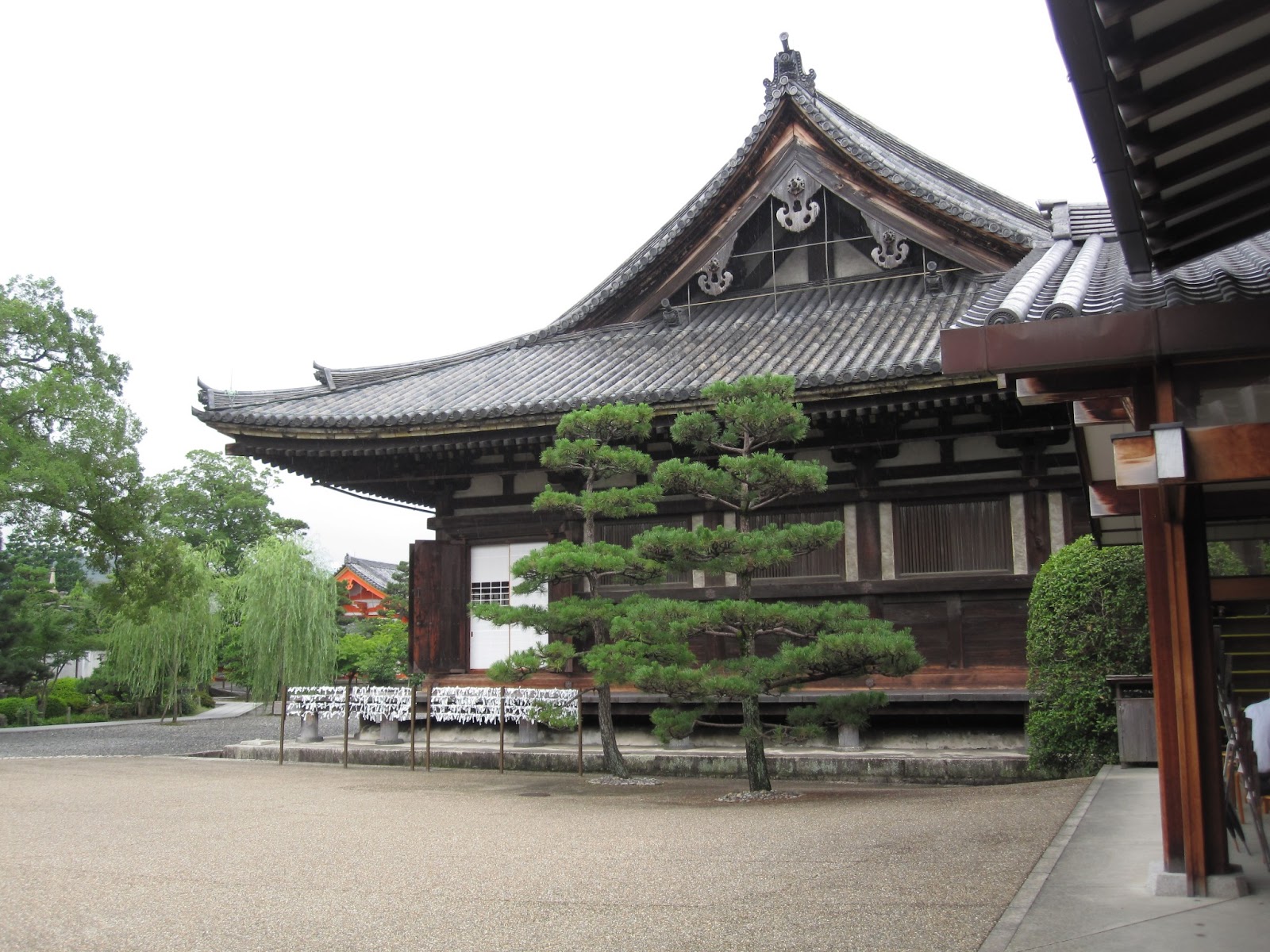
On our last day in Kyoto, we checked out San Jyu San Gendo, another Buddhist temple that happens to be the longest wooden structure in Japan. The "san jyu san" means 33, and there are 33 sections separated by columns in this structure. The temple houses a beautiful Kannon (Japanese Guanyin), surrounded by 1000 armed smaller Kannon, with lesser bodhisattva guarding. The interesting thing about this one is the very obvious direct Indian influence on design and style. 


 Here's a picture I managed to snap off before I was yelled at by the temple shop girl. Like all temples, this temple sells charms and the like. I bought one of these to hang in my classroom next year. ;)

Next stop was the tactfully named "Ear Mound," which houses 40,000 Korean ears from when Toyotomi Hideyoshi attempted to invade Korea and failed miserably. Yep, for real. I guess soldiers used to be paid by each kill they made, which they had to prove by cutting off either ears or noses. Talk about undercutting stereotypes of samurai loyalty.

 Here lie the 40,000 ears. This place was actually deserted. There were no signs toward it and it is marked in Japanese and Korean only, almost as if they want to acknowledge that it exists so they have disclaimer rights, but hope no one ever really catches wind of it.
Also....the 40,000 ear pile is RIGHT next to a playground called "Ear Mound Park." Classic. How do you tell the story behind that name to your kids?

Nara Part 2 - Sumi Ink and Fushimi Inari Shrine

Thankfully, Japan has NOT been like China or Turkey in that no surprise visits to artisan factories or lunch stops conveniently located on the ground floor of a government-sponsored handicraft goods warehouse have occurred. We have done exactly one traditional crafts outing and though undoubtedly Japan Society paid for our experience, we thankfully were not escorted through a gift shop on our way out. We visited a traditional sumi ink maker, one of only 10 in Nara, and it was pretty great, actually. 

So here we're being shown a block of ink just removed from the mold. As you can see--still squishy and twisty! Kind of a strange texture. Sumi ink apparently comes from only a couple of sources, the main one being the soot gathered from smoking pine wood in a long and painstaking process. The liquid kind is from carbon, and has a lesser quality in that it's actually more uniform and will not show light or dark as easily. Additionally, it's difficult to make beautifully artistic rough individual hair lines with the liquid stuff.  In any case, the stuff that he's holding right here takes a long time to make because not only do you have to gather the soot, etc, you also have to let the block of ink harden for at lest 3 months after removing it from the mold. 

We all got to hand-squish a roll of sumi ink to create a the ink bar you see here, in the shape of our grasps. Most people use this as art, apparently, or they place it in their front door as a scent (the ink is perfumed) and a decoration.

After the sumi ink experience, we went to Fushimi Inari Shrine, another Shinto shrine. This is the #1 ranked shrine in Japan, apparently, and is really centered around wealth and dinero.  Quite a different vibe from Kamigamo, as you can see. Bright red and gold for starters. 


 See the fox with a red bib? These little guys were all over the shrine. The red bibs have something to do with children and protection, but Kazuko didn't really know more than that. I actually asked my host family in Obu about the red bib, and she didn't know, so she asked the guy at the office of the shrine we were visiting that day. He said that "it looks good." Right.

 The path up the mountain was lined with torii like this, some big and some small.

 Companies donate money to the shrine to have a torii erected in their honor. Here you see the company names on the left and the date on the right.


 Here's a breaking point in the path where you can see the city further down. I opted to continue and trek the rest of the loop through a mountains. Naturally, a downpour occurred right when I reached the point where it was too far to turn around but far enough to be caught in the rain for a significant amount of time. The little foxes that had looked kind of cute and sly started looking seriously sinister as the sky more or less blackened within minutes and a sheer gush of about an inch of water covered the pavement. I think under normal circumstances, I would've been distraught to be caught out like that, but here I actually found it pretty soothing. I was alone, and the only sound was running water and rain spatters. The air kind of took on that dewy, damp smell that you get in the countryside when it's raining.  I didn't have anywhere to be, and it didn't really matter if I got wet or not. Definitely one of those rare in-the-moment moments.

That said, it's totally unnecessary to ever hike that mountain again. Seen one red torii, seen 'em all. Seriously. They're all the same.